










Whoever loads the trailer at six in the morning is the person who finds out whether you bought the right one.
It won’t announce itself. There’s no dramatic failure. It just costs you an extra trip here, an awkward load there, a ratchet strap run somewhere it shouldn’t go because the mower didn’t quite sit right. Small tax, collected daily, for years.
So it’s worth ten minutes up front. Below is roughly the order we walk through it with crews out of Holland and Zeeland, whether you’re running mowers or hauling pavers and a skid steer.
Learn to read the model number
Model numbers look like alphabet soup until somebody shows you the trick. Then they tell you nearly everything before you’ve walked over to the trailer.
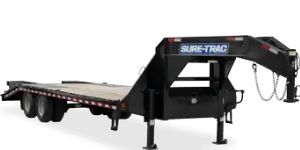
Take a Sure-Trac from our utility trailer inventory, say an ST-UTT8216-070:
- 82 — how wide the deck is, in inches
- 16 — how long it is, in feet
- 070 — what it’s rated to weigh loaded, in hundreds of pounds. So 7,000.
That’s it. A 6208-030 is a 62-inch-wide, 8-footer rated at 2,990. An 8220-100 is 82 inches by 20 feet and rated just under 10,000. Once it clicks you can stand at the end of a row and know which trailers are even worth walking to.
Size it to the crew, not the mower
Almost everybody measures their biggest machine and stops there. But your zero-turn fits on nearly anything. The real question is what rides with it.
- One guy, maintenance only. Zero-turn, walk-behind, trimmer rack, blower. A 6x10 or 7x12 handles that without drama.
- Two-man crew. Move up to an 82-inch deck. The extra room over a 6-footer is what lets you angle a second machine in and still walk down the side of the load instead of climbing over it. Measure your machines at their widest — deck, chute, everything — before you assume two will sit abreast.
- Install and hardscape. Once there’s a skid steer on there, or pallets of block, or rolled sod, 14 to 16 feet stops being roomy and becomes the floor. And at that point weight matters more than length.
One more thing people forget to measure: the gate at their own house. A 20-foot trailer you can’t swing into the yard is a 20-foot trailer you’ll end up hating.
Steel or aluminum on the lakeshore
We sell both, and neither one is the right answer on its own. It comes down to how the trailer lives.
| Steel (Sure-Trac) | Aluminum (Sport Haven) | |
|---|---|---|
| Price | Cheaper, size for size | Costs more up front |
| Weight | Heavier, and it eats payload | Lighter, easier on fuel |
| Our winters | Rusts if you never rinse it | Doesn’t rust |
| Fixing it | Any welder around here | Specialist job |
| Resale | Holds steady | Holds better |
Michigan is hard on steel. Brine goes down in November and doesn’t really stop, the damp coming off the lake never helps, and how fast a frame starts showing rust comes down almost entirely to whether anybody bothers to rinse it.
Rule of thumb: if it’s a workhorse that’ll get dinged and welded back together, buy steel. If it sits outside all year, goes out every day, and you plan to sell it in five rather than run it into the ground, aluminum pays for itself.
One catch before you fall in love with the aluminum argument. Our Sport Haven aluminum stock is single-axle, 6- and 7-foot decks. If your load needs tandem capacity — and a skid steer or a pallet of block does — then on our lot the answer is steel. Give us a ring before you drive out if aluminum and tandem is what you had in mind, because that’s a special order, not something sitting out front.
Mind the 2,990
You’ll notice a lot of single-axle trailers rated at 2,990 instead of a round 3,000. That’s on purpose. Brake rules and plate classes in a lot of states hinge on the 3,000-pound line, so builders park just under it. Worth checking how that shakes out for the way you plan to register and tow, because that one pound is doing a lot of work.
It also catches people out. That rating is the whole loaded trailer, not your cargo. Empty weight comes off the top, and what’s left over is smaller than most folks guess once a commercial zero-turn is parked on it. Mower, full fuel can, couple bags of material, some hand tools. You get there quicker than you’d think.
Two machines, or anything with a skid steer involved, and you want a tandem. Tandems ride better on US-31 and I-196 too, and they stay pointed the right way if a tire lets go. On a trailer that runs loaded five days a week that’s not a small thing.
The stuff you’ll notice in year two
Three details separate a trailer you put up with from one you actually like.
The gate. You use it forty times a day, so a ramp gate that stands up straight and latches properly beats any number on the spec sheet. Lift it yourself before you buy. End of a shift, wearing gloves — that’s the real test.
Tie-downs. Count them, and look at where they actually are. Stake pockets and D-rings in sensible spots are what keep you from strapping to the frame rail and hoping.
The deck. Wood grips well and is cheap to swap. Mesh drains and won’t rot. Neither’s wrong. But a wood deck sitting outside uncovered on the lakeshore is something you maintain, not something you forget about.
Whatever you land on, bearings and brakes are what decide if it’s still working come March. Our service department handles that. And if the trailer that actually fits is one size up from what you meant to spend, financing is usually the difference between buying right once and buying again in three seasons.
Frequently asked questions
What size trailer do I need for a zero-turn?
Most single zero-turns sit fine on a 6x10 or a 7x12. Measure your deck and your discharge chute at the widest point before you commit though, because commercial machines vary more than people expect. What really decides the size is whatever else has to ride along with it.
How much can a 2,990 lb trailer actually haul?
Less than 2,990. That number covers the trailer and everything on it, so knock the trailer’s empty weight off first and what’s left is your real payload. Empty weight is on the VIN sticker.
Is aluminum worth the extra money?
If the trailer lives outside and gets towed every day, usually. No rust, less weight eating your payload, better money back when you sell. If it’s going to take a beating and get fixed at the local shop, buy steel. One catch: our aluminum stock is single-axle only, so if you need tandem capacity you’re looking at steel anyway.
Do I need a tandem axle for landscaping?
One mower and hand tools, no. Two machines, a skid steer, or pallets of block, yes — and it isn’t close. It’s about payload, but it’s also about how the trailer sits behind you at 65.
What’s the real difference between a 6x12 and a 7x14?
Two feet of length and a foot of width. Sounds minor. The width is the part that matters, because that’s what lets gear sit beside gear instead of behind it, and that’s what decides whether you make one trip or two.
Come stand next to a few
Specs on a screen only get you so far. Bring a tape measure, bring the widest machine you own, and bring the list of what has to ride together. Ten minutes on the lot and we’ll point you at the two or three that genuinely work. Have a look at the Sure-Trac lineup before you head over.
Working the Grand Rapids side instead? Our sister store stocks the same utility lineup: utility trailers at Grandville Trailer.